

Introduction: The Value of Holistic Customer Data
In today’s competitive landscape, superior customer experience is the main differentiator. Providing this experience requires more than just good service; it demands a deep, contextual understanding of every client interaction. This is the 360-Degree Customer View: a comprehensive, unified profile within your Customer Relationship Management (CRM) system that aggregates data from all touchpoints—sales, marketing, service, and finance. Implementing this holistic view is the single most effective strategy for enhancing personalization and driving client retention.
The Challenge: Data Silos
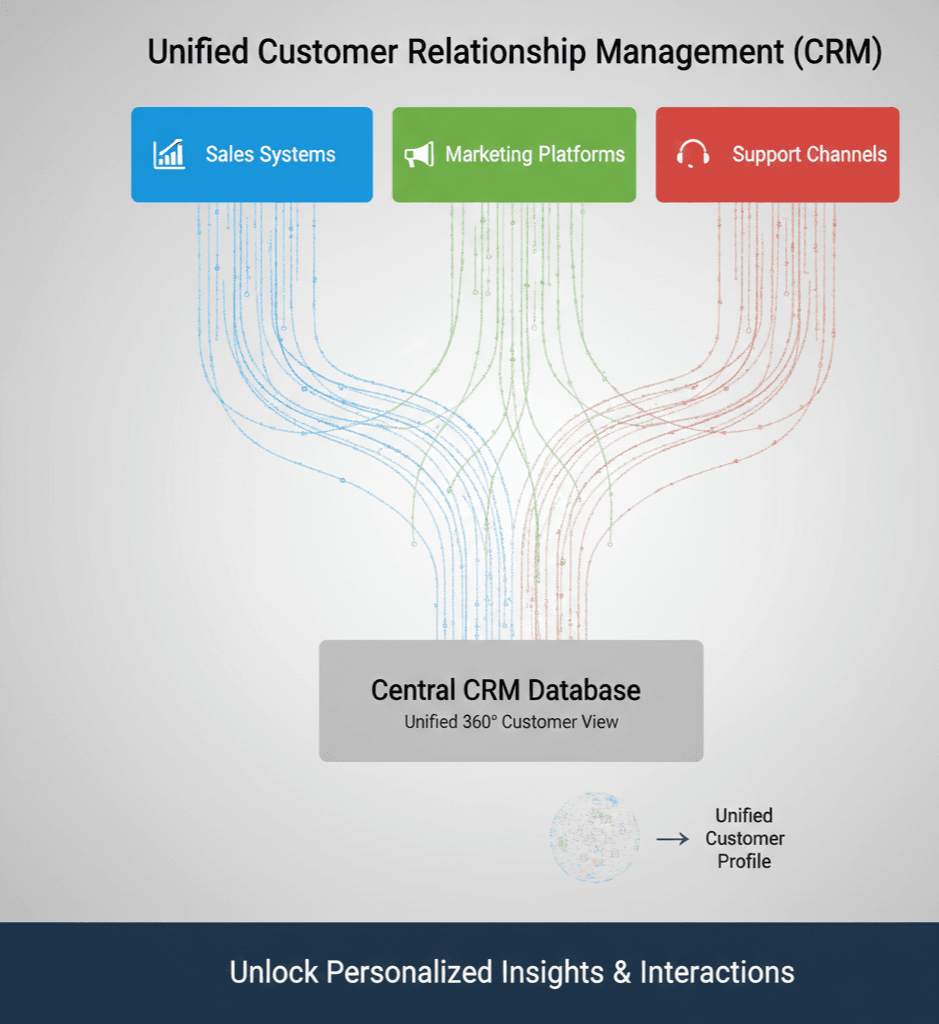
The primary obstacle to achieving a 360-degree view is data silos. Typically, customer information is scattered across disparate systems: transaction history in ERP, service tickets in a separate helpdesk tool, marketing engagement data in an automation platform, and contact records in individual sales spreadsheets. This fragmentation prevents agents and managers from seeing the full customer journey, leading to repetitive questions, frustrating service transfers, and missed sales opportunities.
Phase 1: Integration and Centralization
The foundation of the 360-degree view is bringing all data sources into the central CRM platform.
- Identify All Touchpoints: List every system that captures customer data (website forms, email marketing, phone systems, invoicing, etc.).
- API Integration: Use the CRM’s Application Programming Interfaces (APIs) or native connectors to establish live, two-way data feeds between these systems and the CRM.
- Data Cleansing: Standardize data formats and eliminate duplicate records (deduplication) before integration to ensure data quality and integrity.
Quote: “Data integration is not just a technical task; it is the strategic business decision to treat customer intelligence as a singular, unified asset.”
Phase 2: Defining the Unified Customer Profile
Once the data is centralized, you must define what makes up the unified profile. This goes beyond basic contact information.
- Behavioral Data: Website visits, content downloads, email open/click rates, and social media activity.
- Transactional Data: Purchase history, contract details, total spend, and payment history.
- Service Data: Number of tickets opened, average resolution time, service channel preference, and CSAT scores.
- Contextual Data: Primary contact method, preferred language, and time zone.
The Business Impact: Personalized Action
With a 360-degree view, the ability to personalize interactions drastically improves, leading to higher customer lifetime value (CLV):
- Sales: Agents can instantly identify upsell/cross-sell opportunities based on purchase history and recent support interactions.
- Marketing: Campaigns can be segmented based on service history (e.g., automatically excluding customers with open service tickets from sales promotions).
- Support: Agents can view the customer’s entire history upon connection, eliminating the need for the customer to repeat information and reducing Average Handle Time (AHT).

Conclusion: The Future of Relationship Management
Implementing a 360-degree customer view is a transformative step that converts raw data into actionable customer intelligence. By committing to data centralization and strategic integration, your organization ensures every team member has the context needed to deliver personalized, proactive service, turning customer retention into a predictable engine for growth.







Leave a comment