
Introduction: The Need for Speed and Focus
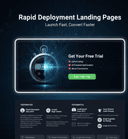
In digital marketing, speed to market and conversion rate are king. Waiting weeks for a developer to finalize a landing page means lost leads and wasted ad spend. Creating high-converting landing pages quickly requires discipline: eliminating distractions and focusing ruthlessly on the core conversion elements. This rapid-fire methodology—which allows you to build a functional, high-performance page in under an hour—is the key to agile lead capture and effective form optimization.
The Principle of Singularity
A landing page has one job: to convert the visitor on a single offer. Every element must support this goal. High-converting pages eliminate navigation menus, extraneous links, and multiple calls-to-action (CTAs). If the visitor has two options, they choose neither.
Step 1: Define the Single Goal (10 Minutes)
Before touching the builder, clarify the offer and the audience.
- The Offer: What exactly is the visitor getting? (e.g., A free guide, a 15-minute consultation, a product demo.)
- The Audience: Who is this page for? (e.g., Small business owners, CTOs, marketing managers.)
- The Promise: What is the specific, quantifiable benefit? (e.g., “Increase your email open rate by 30%”).
Step 2: Craft Compelling Copy (30 Minutes)
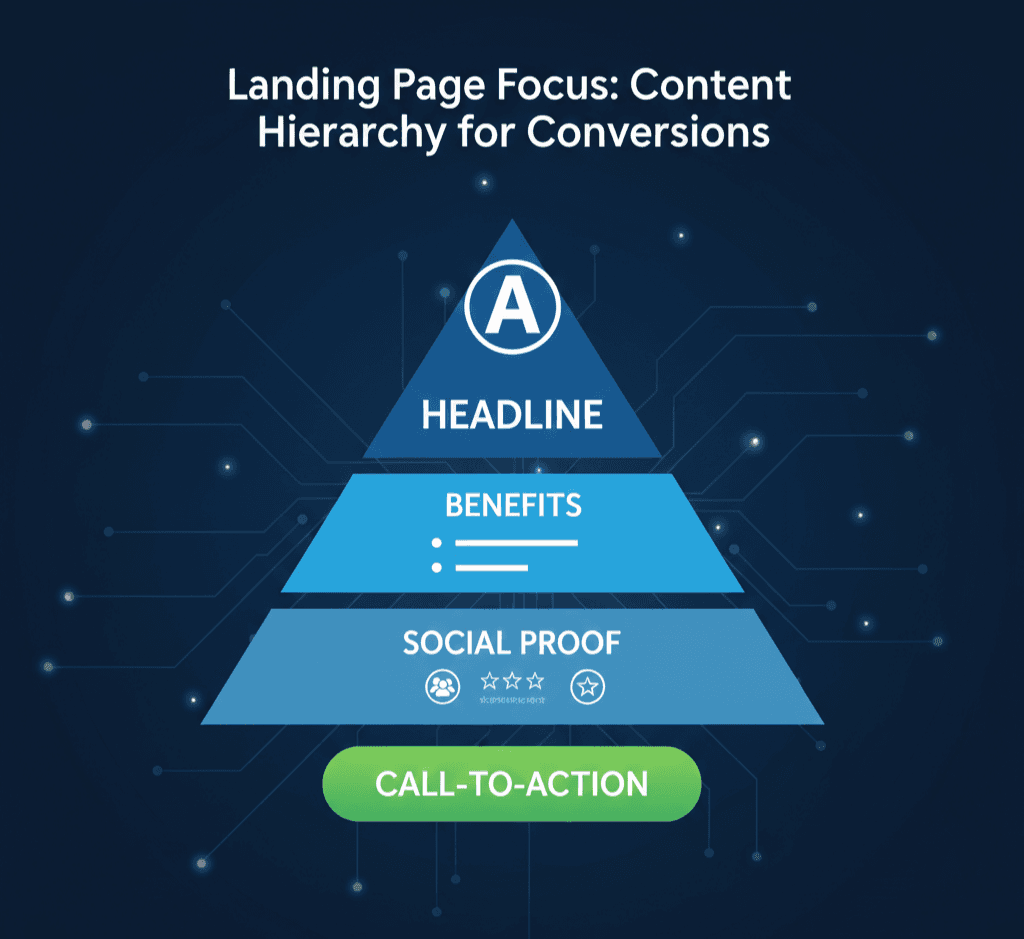
Copy is the most crucial element. Follow the inverted pyramid structure for maximum impact:
- Headline (The Hook): Must be clear, benefit-driven, and match the source ad/email exactly. (e.g., “The Blueprint to a 50% Higher Lead Conversion Rate”).
- Subhead (The Proof): Briefly supports the headline and provides credibility (e.g., “Trusted by 5,000+ businesses globally”).
- Benefit Bullet Points (The Value): Use 3-5 concise bullet points detailing what the lead will get or achieve (e.g., “Identify hidden conversion leaks,” “Get our proprietary form template,” “Instantly audit your current forms”).
- Social Proof: A single, powerful client quote or logos of recognizable clients.
Quote: “Clarity always trumps persuasion on a landing page. The visitor should know the offer within 3 seconds.”
Step 3: Optimize the Form and CTA (15 Minutes)
The form is the point of lead capture and must be frictionless.
- Friction-Free Forms: Use the minimum number of fields required to qualify the lead. For low-value offers (e.g., a guide), ask only for a Name and Email.
- Top-Aligned Labels: Place field labels above the input boxes for quick scanning.
- Value-Driven CTA: The button text must reinforce the value (e.g., “Send Me the Free Blueprint,” not “Submit”). Use contrasting colors (e.g., orange or green) to make it pop.
Step 4: Final Check for Congruence (5 Minutes)
Before launch, ensure the page passes the Congruence Test:
- Does the main headline perfectly match the ad/email the visitor clicked?
- Is the CTA clear and does it reinforce the offer?
- Are there zero navigation links or external distractions?
Conclusion: Rapid Testing for Maximum Lead Capture
Creating high-converting landing pages quickly allows you to test offers and audiences rapidly. By adhering to the principles of singularity, focusing on benefit-driven copy, and ensuring frictionless form optimization, you can deploy lead-capture assets that immediately begin converting visitors into qualified leads, drastically improving your campaign ROI in less time.




Leave a comment