

Introduction: Why a Roadmap is More Than a Calendar
An annual business roadmap is not simply a list of projects; it’s a strategic document that communicates why the company is investing resources in specific areas and how those investments align with the overarching company vision. In the Building & Planning phase, a solid roadmap acts as the foundational blueprint for the year, ensuring every department is pulling in the same direction and minimizing wasted effort. Following these five strategic steps will transform your planning process from chaotic to crystal clear.
Step 1: Revisit and Validate the Vision
Before planning the next 12 months, ensure the entire leadership team is aligned on the 3-to-5-year vision. Ask: Has the market changed? Do our core values still apply? The annual roadmap must be a direct pathway to achieving the next major milestone of that long-term vision. This prevents short-sighted projects that don’t contribute to ultimate company growth.
Step 2: Define Success Metrics and Key Results (OKRs)
Vague goals lead to vague outcomes. A solid roadmap defines success using the Objectives and Key Results (OKRs) framework.
- Objective (O): A qualitative, ambitious goal (e.g., “Become the market leader in the B2B SaaS segment”).
- Key Results (KR): 3-5 measurable, specific targets that confirm the Objective was met (e.g., “Achieve 20% Net Revenue Retention,” “Reduce Customer Churn to below 5%,” “Increase Average Deal Size by 15%”).
The roadmap should prioritize initiatives that directly impact these KRs.
Step 3: Conduct a Gap Analysis and Prioritize Initiatives
With your OKRs defined, perform a Gap Analysis: What resources, products, or processes are currently missing to achieve the KRs?
- Initiative Brainstorm: List all potential projects (e.g., “Build new CRM integration,” “Hire 5 senior engineers,” “Launch new content series”).
- Prioritization Matrix: Use a framework like the RICE (Reach, Impact, Confidence, Effort) or MoSCoW (Must have, Should have, Could have, Won’t have) method to rank projects. Only the highest-impact initiatives that directly support the KRs make it onto the final roadmap.
Quote: “The main thing is to keep the main thing the main thing.” – Stephen Covey. The roadmap’s power is in what you choose to defer.
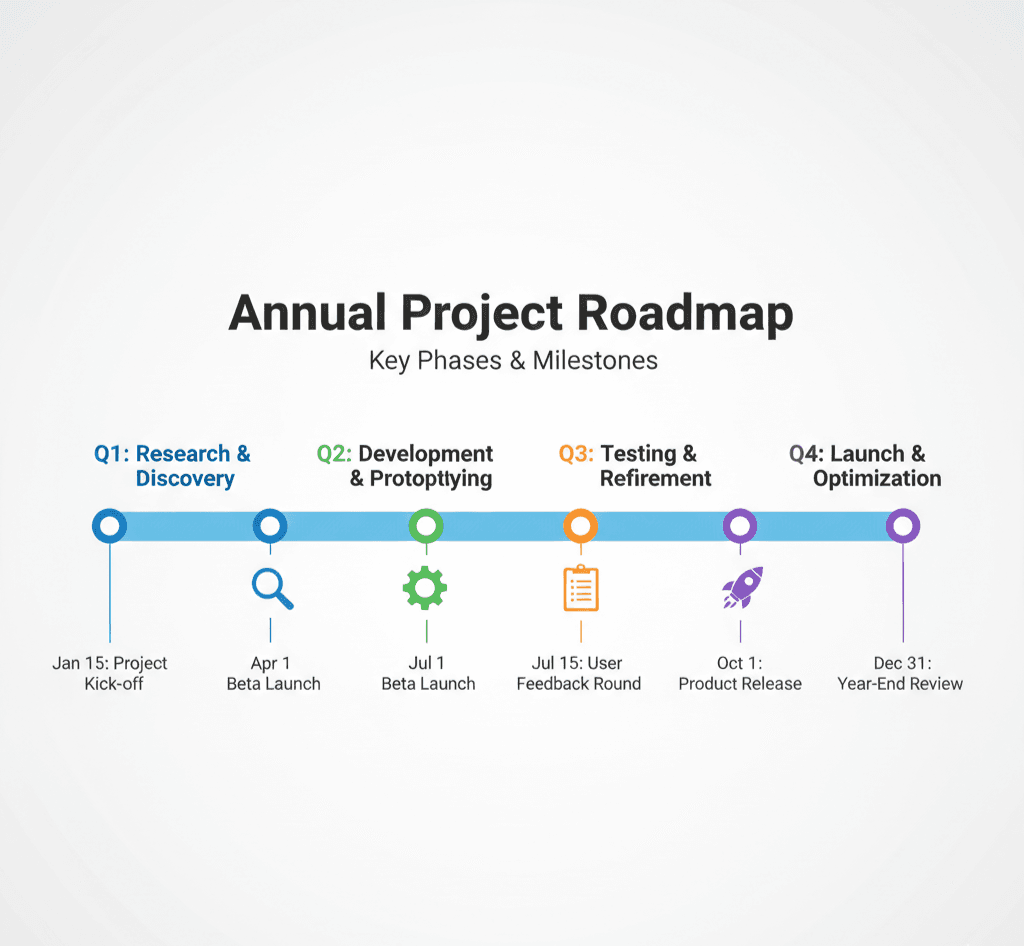
Step 4: Visualize and Phase the Timeline (Quarterly Sprints)
An annual roadmap is overwhelming if viewed as a single block. Break it down into digestible, manageable quarterly phases.
- Q1: Foundations: Focus on essential staff hiring, infrastructure building, and foundational product enhancements.
- Q2/Q3: Growth & Execution: Launch major product features, expand marketing campaigns, and focus on customer acquisition.
- Q4: Review & Refinement: Focus on audit, optimization, and preparing the budget/strategy for the following year.
The visualization should clearly show dependencies between quarterly goals.
Step 5: Define Risk Assessment and Flexibility
The best plans are adaptable. Before finalizing the roadmap, identify the top three risks (e.g., unexpected competitor entry, economic downturn, hiring delays) that could derail the plan.
- Contingency Planning: Assign a budget or an alternative initiative (Plan B) to mitigate each risk.
- Review Cadence: Schedule monthly or quarterly roadmap review meetings, not to critique performance, but to assess market shifts and adjust priorities without losing sight of the annual objectives.

Conclusion: The Path to Long-Term Success
A solid annual business roadmap is the single most powerful tool for achieving long-term professional and corporate goals. By committing to vision alignment, measurable OKRs, and disciplined prioritization, you build a clear, strategic path forward that transforms abstract goals into concrete, actionable steps.






Leave a comment